Try Incompass free for 30 days. No credit card required.
Start Free Trial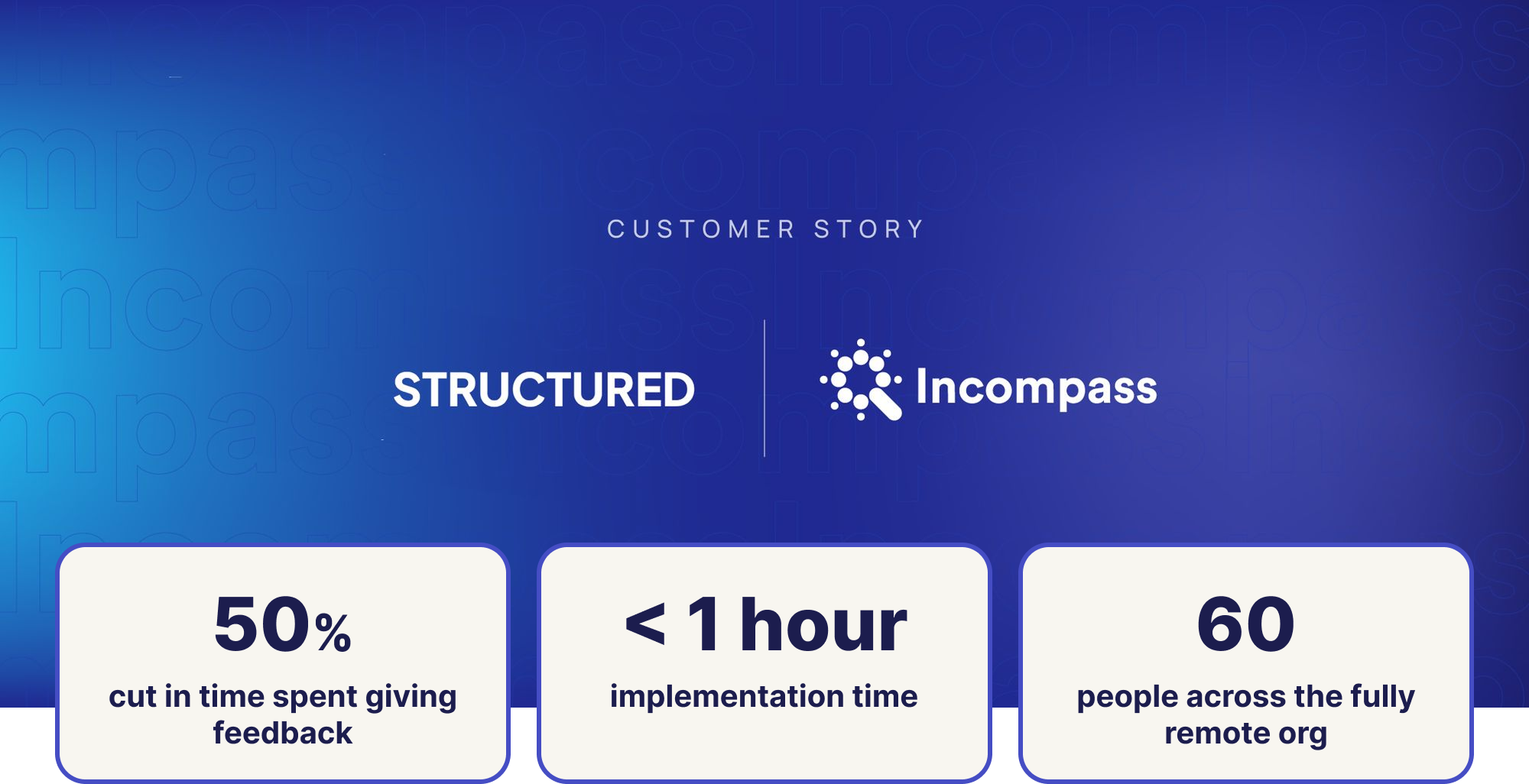


Remote and hybrid work are no longer edge cases. Nearly half of all roles now fall into one of these categories — more than double the pre-pandemic rate. And yet, leaders still cite culture as one of their strongest competitive advantages. For fully remote companies, this creates a real tension: how do you understand your talent, reinforce shared values, and make confident decisions about your people — without the visibility that in-person work naturally provides?
Structured, a 60-person fully remote marketing agency, set out to answer that question.
Founded in 2018, Structured had grown steadily — and, for much of that growth, without many formal people processes in place. As the company considered how to sustain that trajectory, leadership recognized that retaining and developing talent, and being more intentional about culture, would be critical levers. They hired Andrea Evans as Head of People to lead the effort.
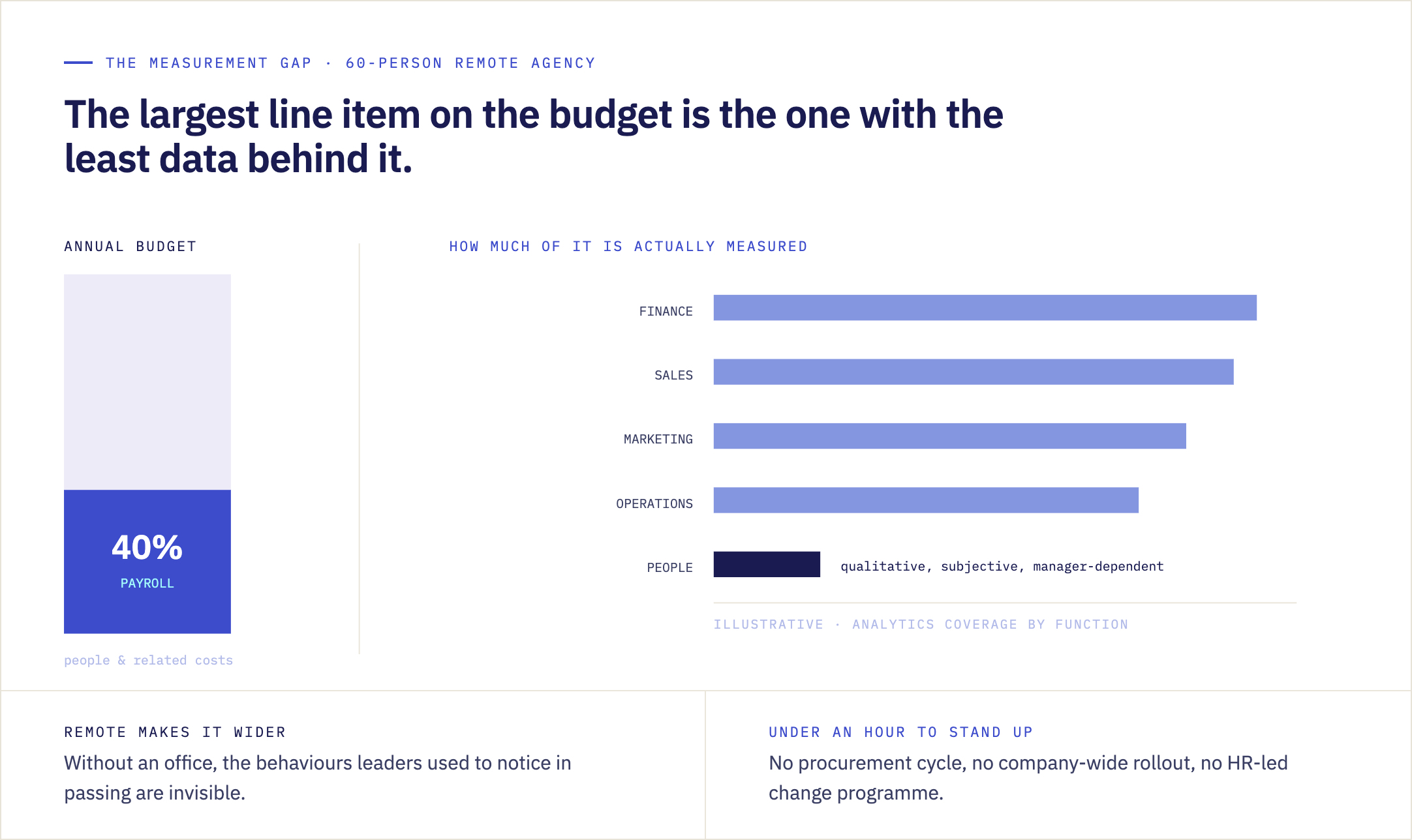
Andrea's challenge was one that resonates across the industry: companies on average spend roughly 40% of their annual budget on payroll and related expenses. Yet in an era when analytics are pervasive across every other business function, the data leaders have to understand and optimize that investment remains largely qualitative, subjective, and incomplete. For a remote company, where observable behaviors are harder to spot in the first place, the gap is even wider.
Andrea's first priority was connection — not leaving it to chance, but designing it intentionally. She introduced a series of weekly rituals to give people formal and informal reasons to build relationships across a distributed team.
When Andrea shared these rituals in a LinkedIn post, over 37,000 people responded — a signal that this is a challenge far beyond Structured alone. Employees noted that the rituals were bringing teams closer together, connecting them with colleagues they didn't usually interact with, and building stronger connective tissue across the business.
With a foundation of connection in place, Andrea turned her attention to a deeper problem: Structured had a strong set of company values, but no consistent way to understand how well those values were actually showing up across the organization.
This is a common blind spot. Most companies set goals for what employees need to accomplish — but very few measure how employees are expected to work. And even where expectations exist, assessments tend to be subjective, manager-dependent, and disconnected from the broader picture. Leaders are left making significant talent decisions without reliable data to back them up.
To close this gap, Andrea implemented Incompass as a way to get clear, trusted visibility into talent and impact across the business. Critically, it didn't require a heavy, company-wide rollout or HR-led implementation. Andrea was able to stand it up in under an hour and start with what mattered most.
She chose Incompass for four reasons:
Fast time to value. With support from the Incompass Customer Success team, implementation took less than an hour — no lengthy procurement cycle, no organizational change required.
A faster, more accurate experience for employees. Incompass's interactive sliders and AI-assisted input cut the time employees spent providing feedback in half — while also increasing the quality and accuracy of what was shared. This made it sustainable to move from an annual process to a much more frequent cadence.
Clear visibility into who is driving impact. Incompass automatically calibrates inputs across the organization — giving leaders the ability to spot high-potential talent, identify which teams are thriving, and surface where there may be alignment gaps or culture dead zones. This is the kind of clarity into contribution that's nearly impossible to get from traditional tools.
Flexibility as the business evolves. In Andrea's words: "The platform is great for measuring alignment with our values, but it's stretchy enough to give us a broad view of talent performance — which is where the real value lies."
Visibility is only valuable if it leads somewhere. Andrea recognized that culture is reinforced when people see that shared expectations actually matter — and that those who live the company's values are recognized and rewarded for it.
With Incompass in place, Structured gained ongoing clarity into how values were showing up across the organization. Employees received personalized insights and development recommendations. Leaders gained the data they needed to make talent decisions with confidence — moving away from gut instinct and subjective manager assessments toward something more objective and defensible. Bonus allocation and promotion readiness discussions were tied directly to this data, aligning how Structured recognized and rewarded people with what the organization actually valued.
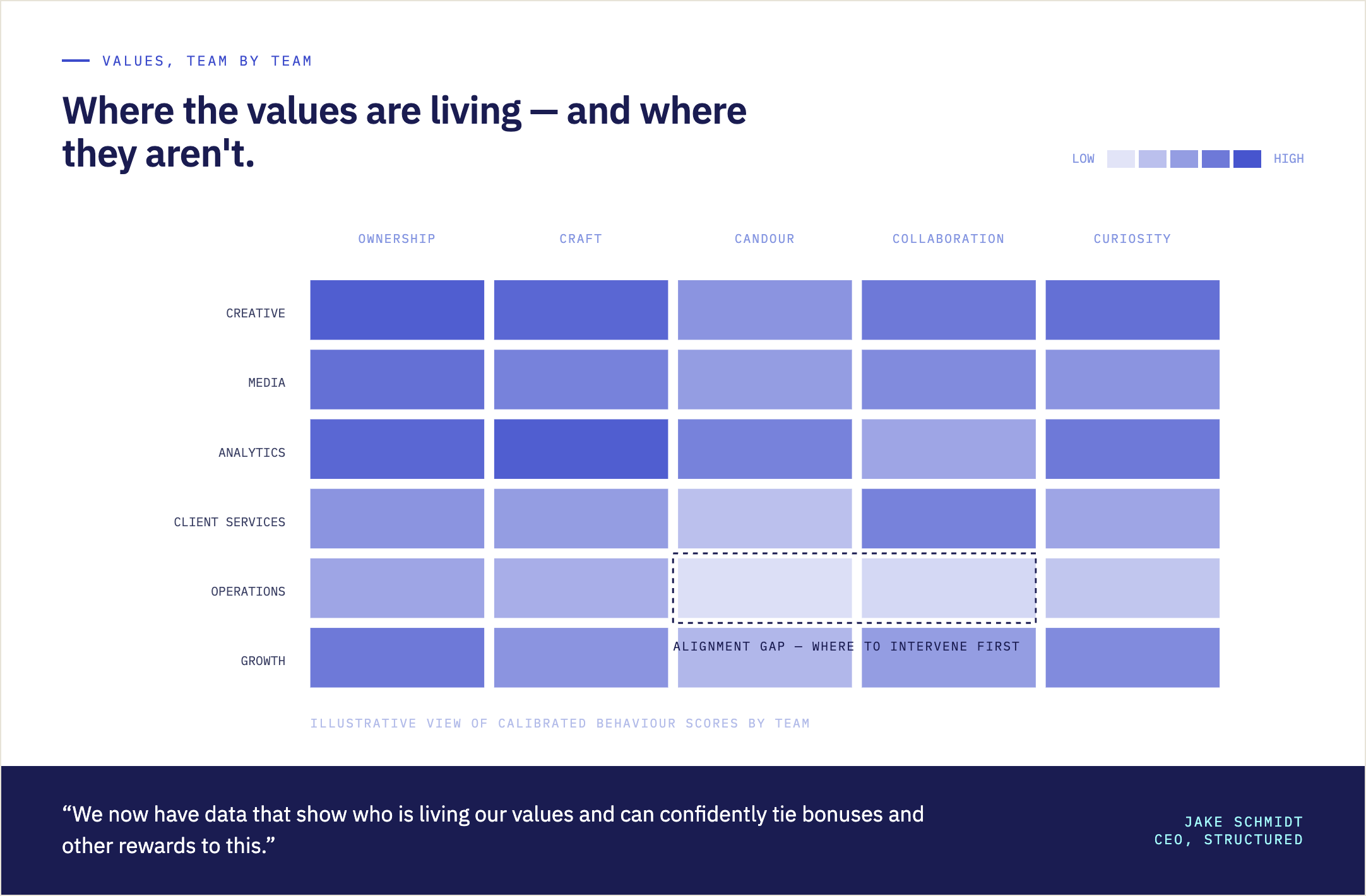
As CEO Jake Schmidt put it: "I am thrilled that we now have data that show who is living our values and can confidently tie bonuses and other rewards to this. I believe this will be a critical building block for our future success."
Structured's experience points to something broader: the companies that will win on culture — especially in remote and hybrid environments — won't be the ones with the best values statements. They'll be the ones with the clearest picture of who is actually driving impact, and the confidence to act on what they see.
What works today may evolve tomorrow — but when culture is built by design, teams are better equipped to grow together, wherever they work.
Curious to see how Incompass works? We'd love to chat, or try it yourself!