Try Incompass free for 30 days. No credit card required.
Start Free Trial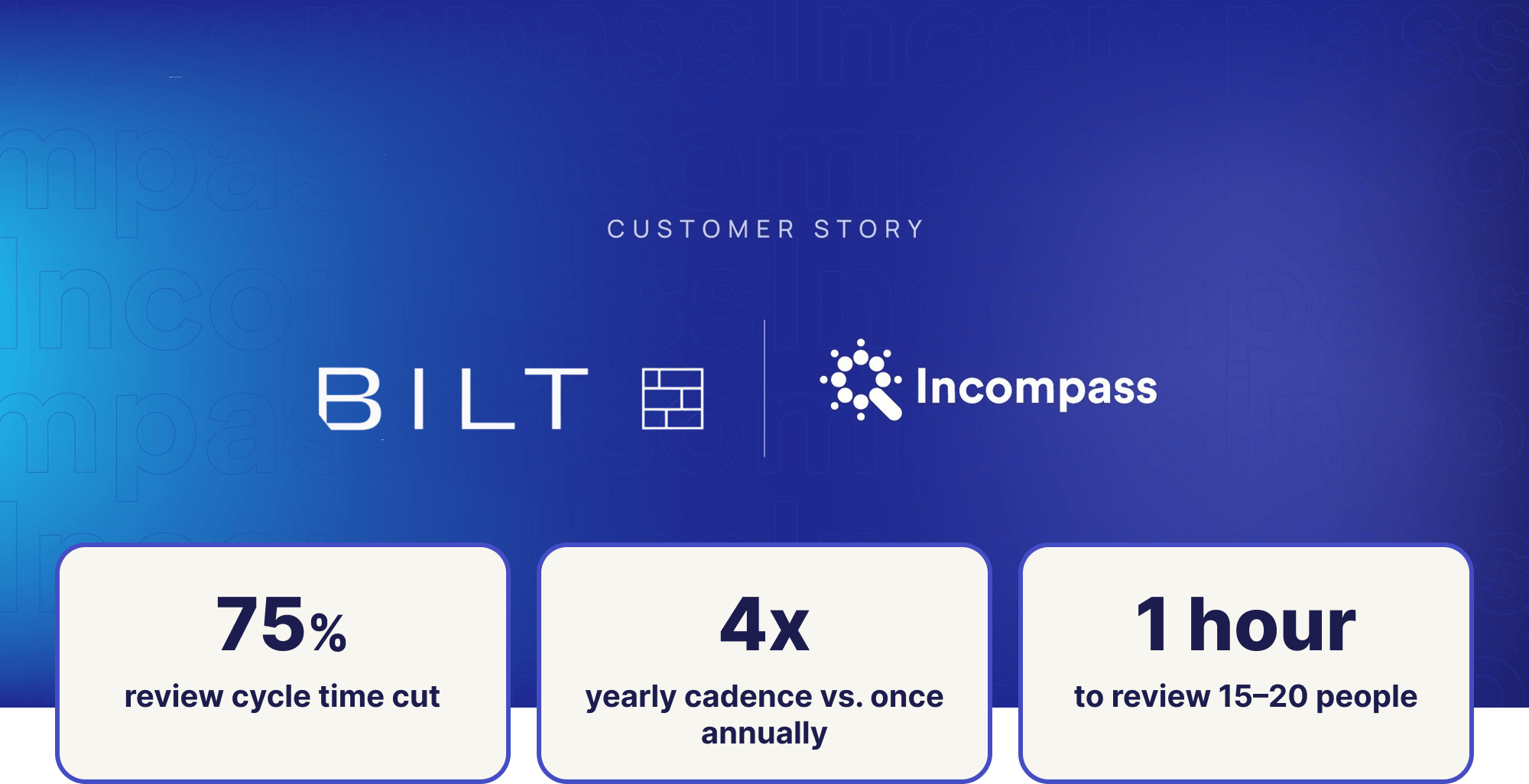


Bilt is a membership for where you live that allows members to earn rewards on rent or mortgage, get connected to the businesses around you, and now, have a concierge that manages your neighborhood life the way a great hotel manages a stay. Since launching out of a venture studio in early 2020, the company has grown to 250+ employees and is deliberately structured around speed.
The engine behind Bilt’s speed is their "pod” model: 12 cross-functional teams of no more than 25 people, each led by a General Manager. By design, a GM doesn't need a technical background to lead an engineering-heavy team. What Bilt cares about isn't necessarily how well you can write code, it's whether you deliver, own your work, and grow.
But, that model creates a talent intelligence problem that traditional tools weren't built to solve. As Bilt scaled past 150, then 200, then 250 employees, the informal visibility leaders once had into who was driving impact started to dwindle. Ciara O'Sullivan, Senior Director of People since the company's earliest days, was at the center of figuring out how to get it back.
"We needed something to review these cross-functional teams. In our world, the actual skill set matters less … we know you can code if you're an engineer. The question becomes, how are we looking at the behaviors on top of that?"
— Ciara O'Sullivan, Senior Director of People, Bilt
Before Incompass, getting a clear picture of talent across the organization was largely an exercise in intuition. Ciara managed review cycles through a combination of Google Sheets, Google Forms, and various survey tools — compiling qualitative feedback by hand, sorting through long written responses, and trying to surface the people who deserved recognition but might otherwise go unnoticed.
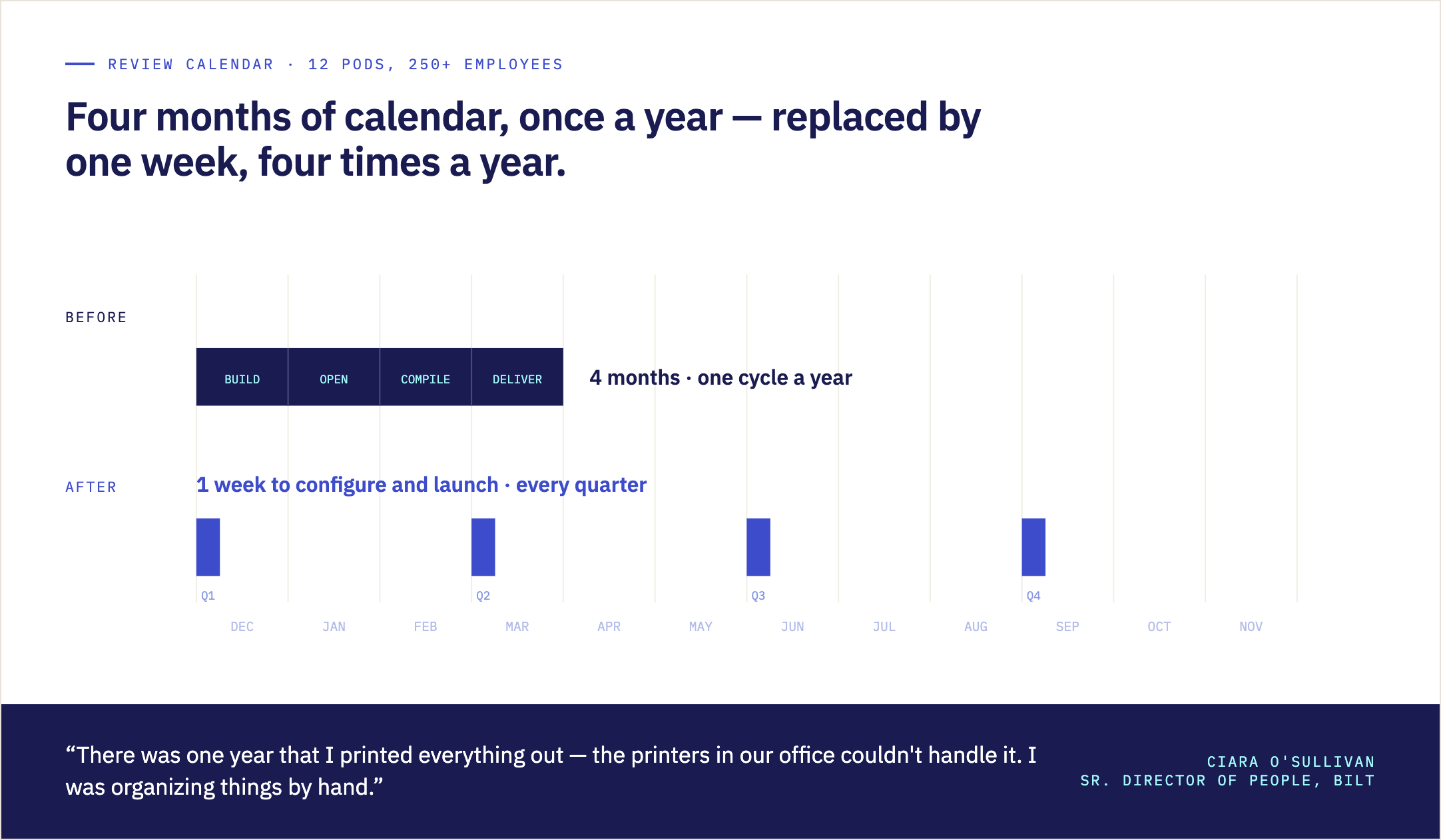
The calendar was consumed by it. December was for building surveys and getting executive sign-off. January was when reviews opened. February — the entire month — was dedicated to manually compiling, reading, and synthesizing feedback. March was for delivering it. In earlier cycles, Ciara would sit in on every single review conversation, taking a lot of her time.
"I had a lot of qualitative feedback, not a lot of quantitative stuff, a lot of long written responses. There was one year that I printed everything out — the printers in our office couldn't handle it. I was organizing things by hand." — Ciara O'Sullivan
The bigger cost wasn't the time. It was what happened on the other side of that process: decisions made on instinct rather than data, and contributors who slipped through the cracks because the signal was too buried to surface.
"The previous way of doing things was very much finger in the air. Very, ‘we think this person's doing well’. Incompass has really given me a world where I can say: here's the data, here's what your team is doing. There are no questions." — Ciara O'Sullivan
Running reviews quarterly didn't just save time; it generated enough data to actually see patterns. Ciara and her team use the platform at two levels simultaneously. At the macro level, they tracked organization-wide trends: ownership scores, AI fluency, pod-level patterns — to prioritize hiring, training, and structural decisions. At the micro level, they sat with individual managers to review team dashboards, surface standout contributors, and identify people who needed development or support.
One of Bilt's assessment behaviors is AI fluency. After their first cycle, the data surfaced a clear gap: go-to-market teams were less fluent in AI tools than their engineering counterparts. Bilt acted on it: launching a dedicated AI channel in Slack, rolling out new tools, and creating structured spaces for employees to experiment and share what they were learning.
"It really informed where we had efficiencies and deficiencies as a business. My only goal is to make sure that people have the skills they need to be successful. AI was one very clear area where the data said: there's real growth that can happen here." — Ciara O'Sullivan
The ownership behavior — one of Bilt's most defining cultural values — is tracked the same way. Incompass data helps Ciara's team identify when someone's scope has expanded to the point where a structural change may be needed.
"What Incompass has enabled us to do is say: yes, this person's ownership is what we think it is, or this person's ownership is actually too much. They probably need support. Let's think about what this person's role looks like." — Ciara O'Sullivan
There's a reason annual reviews became the default: the process is simply too heavy to run more often. For most people teams, building surveys, getting sign-off, opening the cycle, compiling and synthesizing feedback, and delivering it consumes months of calendar once a year. Running it twice would be ambitious. Four times is inconceivable.
Bilt wanted quarterly from the start. Their employee base — highly motivated, startup-minded, driven to keep improving — wanted feedback more than once a year. Waiting twelve months to tell someone where their ownership had grown, or where it was stretched thin, wasn't compatible with the pace Bilt operated at. But wanting quarterly and being able to run quarterly are two different things. The constraint was never ambition, it was the weight of the process itself.
"Employees generally have a very negative connotation with performance reviews. They happen once a year, they're this big arduous cycle. And for us at Bilt, I was really looking for a tool that I could use quarterly. If I'm using a tool quarterly, I don't want to dread using the tool. And if I can get up in front of a team meeting and really speak positively and energetically and excitedly about this thing, that's contagious to employees too. It wasn't until our second cycle that our employees were like: performance cycles are nothing. And I'm like, that is exactly where we want to be." — Ciara O'Sullivan
With Incompass, Bilt's second full review cycle launched within a week of setup, from configuration to open.
Before Incompass, managers spent the entire two-week review window working through forms. With Incompass, most now complete feedback for teams of 15 to 20 people in about one hour — and some finish in as little as 30 minutes. For a process that once consumed weeks, that's not an incremental improvement; it's a different relationship with the task entirely.
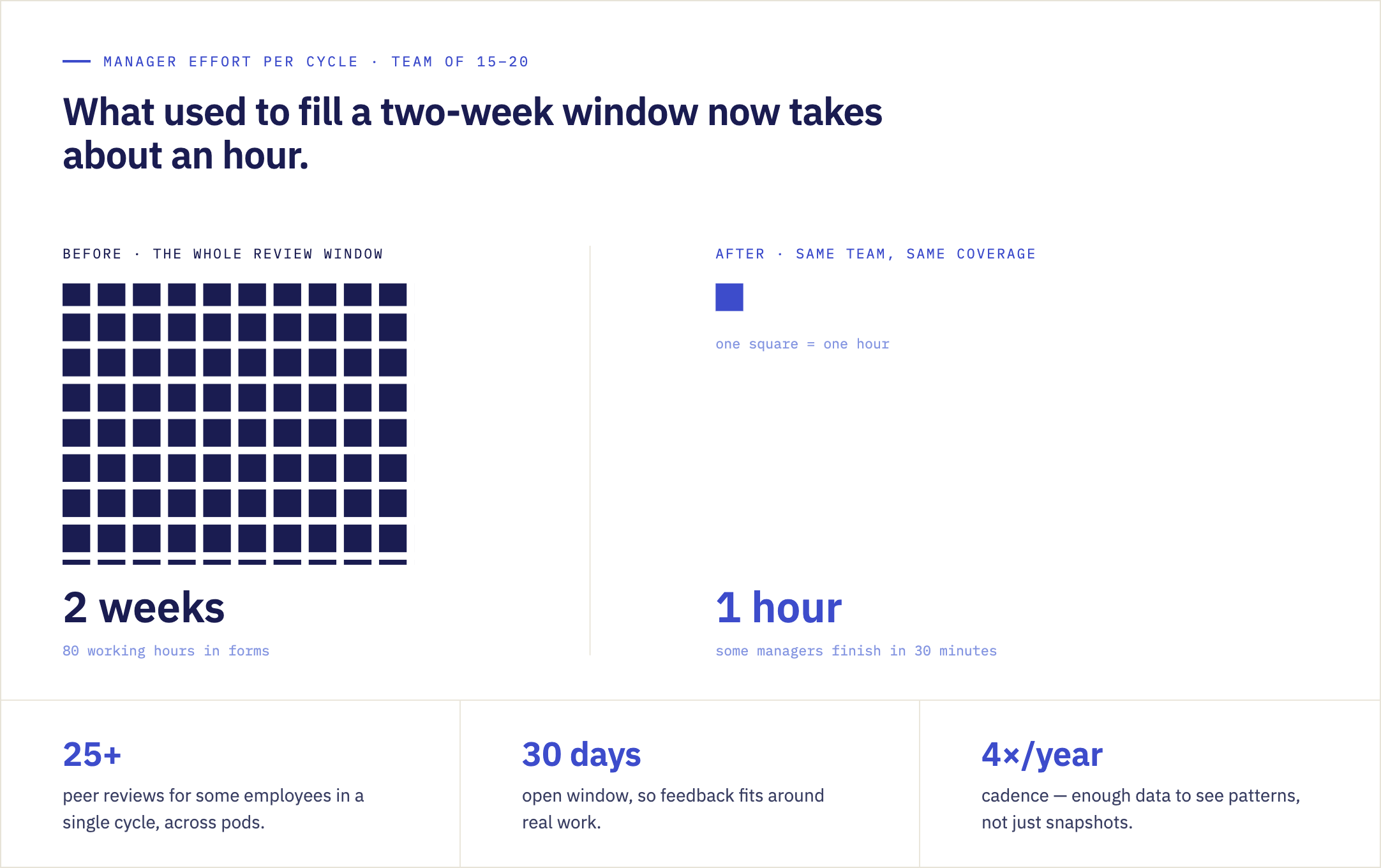
At the cycle level, what once consumed Ciara's entire month of February now takes a week to configure and launch. Review windows stay open for 30 days so employees can complete feedback on their own schedule without it feeling like a burden.
Peer visibility scaled significantly too. With cross-pod reviewing enabled, some employees received more than 25 peer reviews in a single cycle, surfacing contributors who would never have appeared in a traditional manager-only process.
The AI-generated summaries became a standout for managers. Rather than assembling feedback from raw inputs, Incompass generates summaries grounded in the specific behaviors employees were assessed on — thereby giving managers a consistent, reliable starting point for every conversation.
"The LLM in Incompass knows the behaviors that people were being graded on. It's giving managers this beautifully written, nicely summarized feedback. And I know that it's consistent, and that it hasn't gone off the rails." — Ciara O'Sullivan
For Ciara, one of the most meaningful outcomes has been cultural, and it rippled outward from her team to the broader organization. When executives and senior leaders saw that employees weren't dreading the process — that they were engaging with it, completing it faster than anyone expected — it changed how Incompass was perceived across the business. It stopped being a performance tool and became something the whole organization had a stake in.
"When a people team tool wins, you feel it throughout the organization because people aren't dreading doing the thing that tool is supposed to make better. And on my side, when I know I can trust the data and that the right things are being surfaced to me, that's a win-win on both sides." — Ciara O'Sullivan
For a company allergic to unnecessary processes, that matters. Bilt didn't adopt Incompass because they wanted a heavier review system; they adopted it because they needed to see their talent clearly: across 12 pods, at a quarterly cadence, in a form executives could act on and employees would actually use.
Bilt's experience points to a challenge that scales with every hire. As organizations grow, the informal visibility that leaders once had into who is driving impact quietly disappears. The instincts that work at 50 people don't hold at 150 or 250 — and by the time most leadership teams realize that, they've already been making consequential decisions on gut rather than data for years.
The answer for Bilt wasn't a more rigorous process; it was a fundamentally different relationship with talent data: knowing, at the pod level, every quarter, exactly who was driving impact, where ownership was stretched too thin, and who deserved to be seen but wasn't. That's not a people team problem; that's a business intelligence problem. And it doesn't get easier as you grow; it
only gets harder.
Incompass gave Bilt the visibility to act on what they were already sensing and the data to stop guessing.
Curious to see how Incompass can support your teams? Book a demo to see it for yourself.