Try Incompass free for 30 days. No credit card required.
Start Free Trial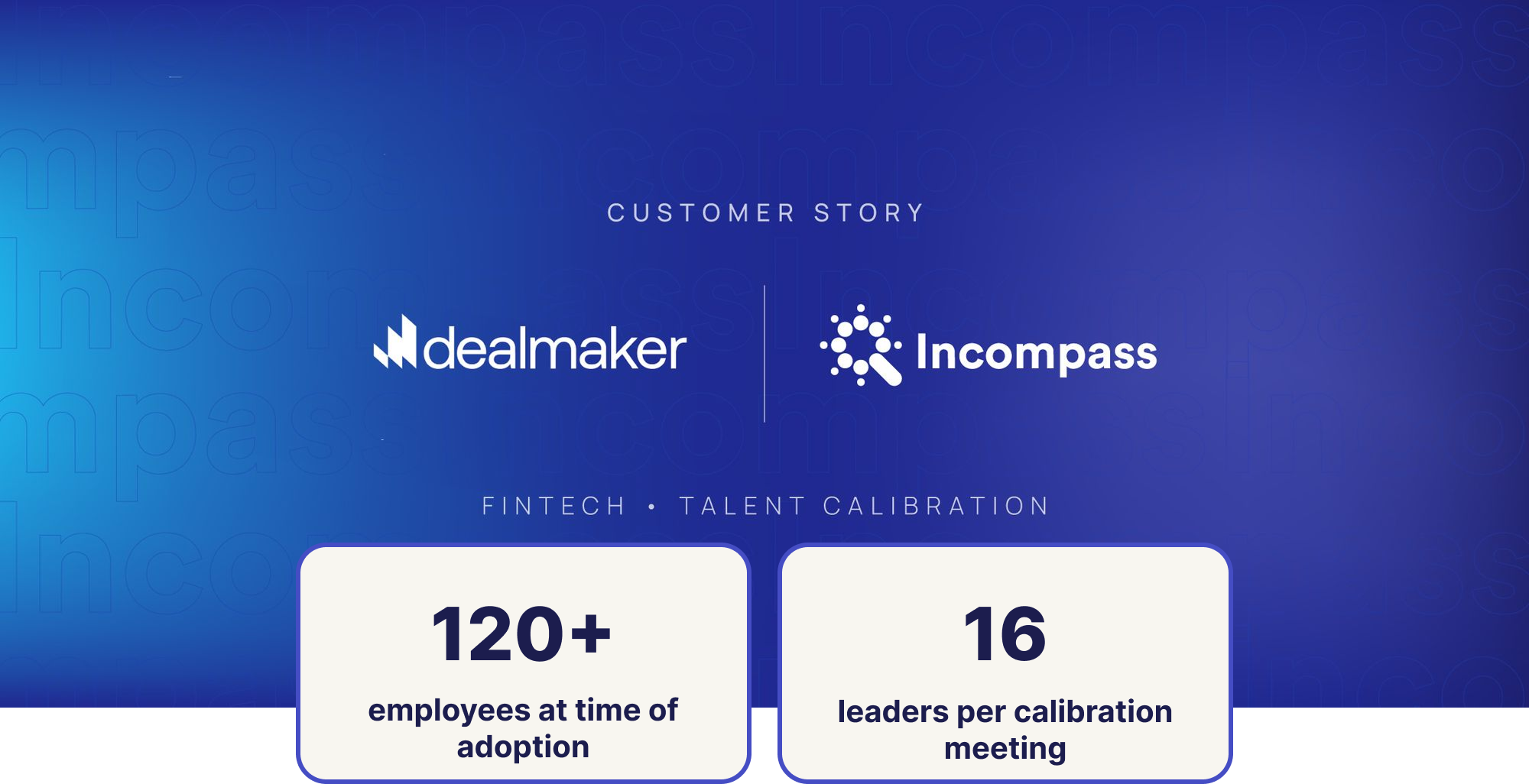


Talent decisions are among the most consequential — and most expensive — calls a leadership team makes. Yet most organizations are making them with incomplete data, memory bias, and processes that weren't built to scale.
The problem isn't just speed or efficiency. It's that the data most leaders rely on is quietly distorted — shaped by whoever spoke up most recently, whoever rated most generously, and whatever outcomes were easiest to measure. Over time, those distortions compound. The wrong people get overlooked. The right people don't get the investment they deserve. And leaders lose confidence in the very decisions that matter most.
For DealMaker, a fintech company that had grown past 120 employees, that gap was becoming impossible to ignore. This is how they closed it.
DealMaker built its early processes in Google Sheets, with a lightweight 360 layer on top. For a smaller team, it was workable. As headcount grew, the cracks became harder to ignore.
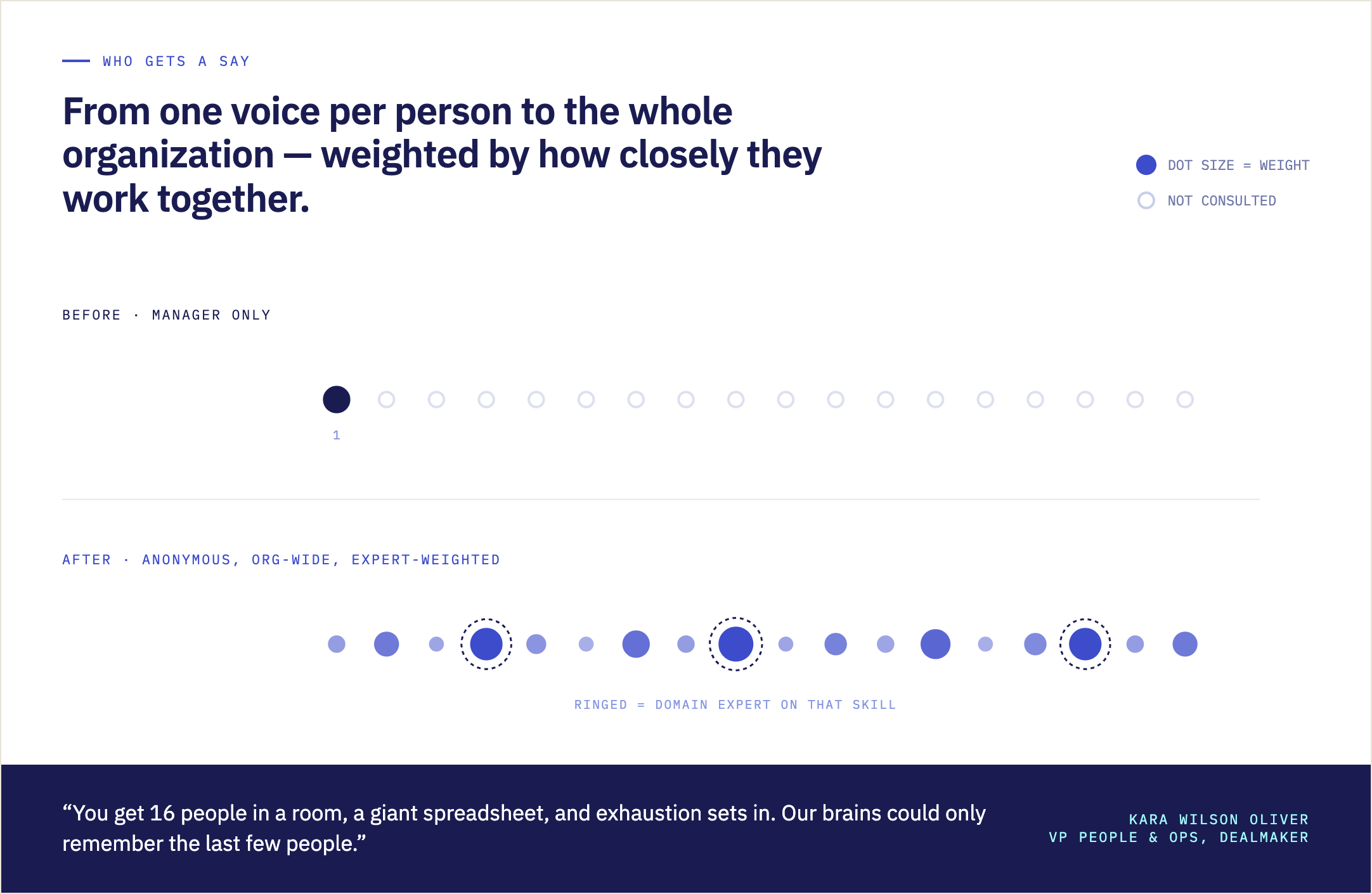
Calibration sessions brought as many as 16 leaders into a room with a sprawling spreadsheet — and the results were predictably inconsistent. Assessments skewed toward whoever had spoken up most recently or most loudly. The data couldn't correct for it.
As Kara Wilson Oliver, VP of People & Operations at DealMaker, described it:
"You get 16 people in a room, a giant spreadsheet, and exhaustion sets in. Our brains could only remember the last few people, and the process didn't feel statistically significant."
The volume problem was solvable. The data problem was more serious.
DealMaker's existing system tracked outcomes — sales numbers, project delivery — but had no way to capture the behavioral qualities leadership considered the real predictors of long-term success: adaptability and tenacity. Managers tried to surface these traits during hiring, but once someone was inside the organization, there was no consistent way to measure or track them.
The result was a process that could tell you what someone had delivered, but not how they were showing up — or whether they were the kind of person the company should be betting on long-term.
For Kara, this wasn't a process inconvenience in as much as a strategic risk:
"Performance management is non-negotiable. It's the founding layer for HR to prove itself as a business function."
When DealMaker began evaluating solutions, the bar was high. They needed something that could widen the data set, correct for bias, and surface the behavioral signals that spreadsheets couldn't capture.
Incompass stood out for several reasons:
Broader, more balanced input: The platform enabled anonymous feedback from across the entire organization — not just managers — giving leaders a fuller picture of how each person was actually showing up at work.
Bias detection built into the process: Incompass uses machine learning to detect rater tendencies in real time — whether someone consistently scores high or low — and corrects for greater precision. This happens live, not after the fact.
Expert-weighted feedback: Not all perspectives carry equal weight. When a recognized expert in a particular domain gives feedback on that skill, Incompass weights their input accordingly — making the data more meaningful, not just more voluminous.
Immediate adoption, without lengthy rollouts: DealMaker isn't a company that invests heavily in software training. They needed something intuitive from day one.
"We're not a company that spends a lot of time on training, so I needed a system people could just get. Incompass delivered on that — it was intuitive from day one, and people immediately saw the value."
The most immediate shift was in how calibration actually worked.
Rather than reconstructing assessments in long post-cycle meetings, leaders worked with data that had already been calibrated — bias corrected, expert-weighted, and drawn from across the organization. The heavy lifting moved out of the meeting room and into the platform, freeing leadership to focus on the cases that genuinely required human judgment.
The platform also introduced a subtle but important forcing function: where legacy tools allowed the same score to be assigned to many people, Incompass required finer gradations. That pressure to be specific turned blanket ratings into defensible, differentiated assessments — and made the final calibration conversation far more strategic.
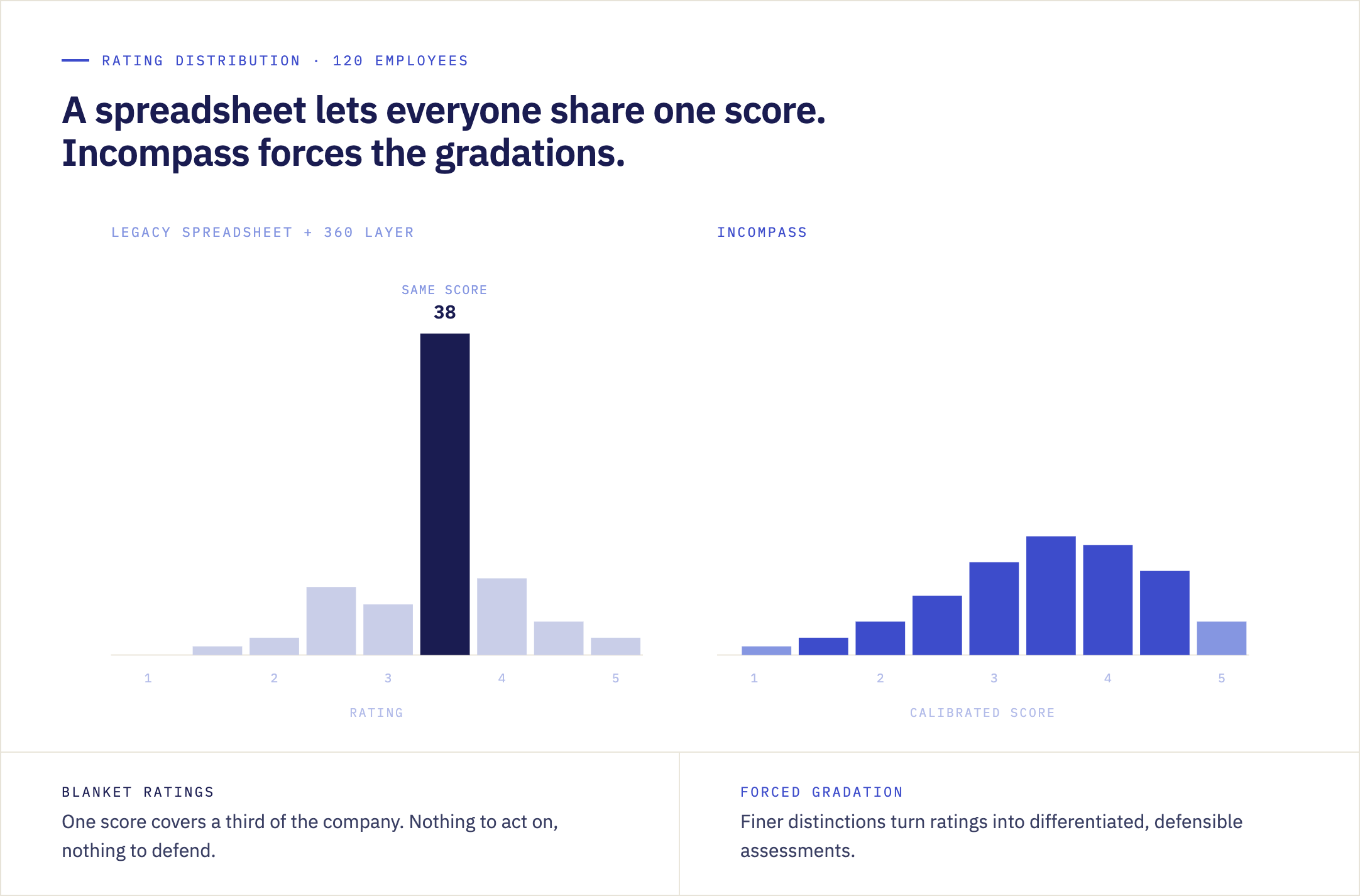
The results went beyond efficiency. The quality of conversations improved, the data was more defensible, and — perhaps most tellingly — the people who were most skeptical came around.
"Even the skeptics realized this was a better way. We actually got kudos from people who don't normally give kudos. That never happens. The weight of the work had already been done — we didn't have to burn mental energy on the basics."
For DealMaker, adopting Incompass wasn't an incremental upgrade to an existing process. It was a shift in how the organization approaches its most consequential decisions.
Talent decisions don't just affect cycles — they affect trust, engagement, and the trajectory of the business. Getting them wrong is expensive in ways that don't always show up on a dashboard. Getting them right compounds over time.
As Kara put it:
"Talent is your most expensive investment. Getting it wrong undermines trust and engagement. Getting it right changes everything."
With clearer data, faster calibration, and broader input built into the process, DealMaker now makes talent decisions that are faster, fairer, and built to hold up at scale.
DealMaker's experience points to a challenge that isn't unique to fintech, or to companies at 120 people. Most organizations are making their most important talent decisions — who to promote, who to invest in, who is truly driving impact — with data that is incomplete, biased, or both.
The distortions are rarely intentional. They're structural. When visibility into contribution depends on who speaks loudest in a calibration meeting, or which behaviors happen to be easiest to measure, the best people don't always rise to the top — and leaders lose the clarity they need to build teams that scale.
Incompass was built to close that gap: giving leaders trusted, real-time visibility into who is driving impact and how — so that the decisions that matter most are grounded in something more defensible than memory and instinct.
Ready to make talent decisions you can defend? See how Incompass helps leadership teams replace bias and spreadsheets with calibrated, evidence-based talent data.