Try Incompass free for 30 days. No credit card required.
Start Free Trial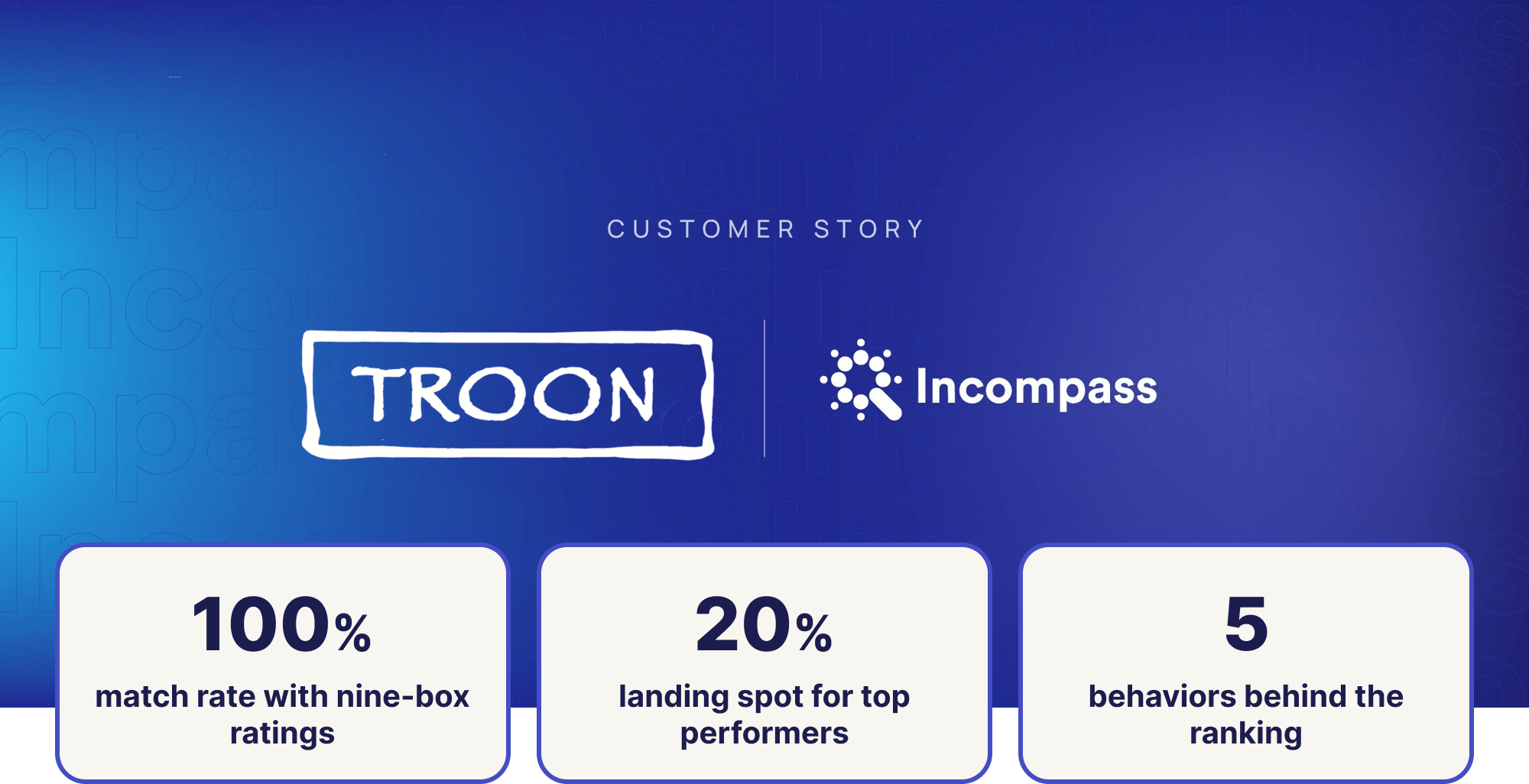


Tim Schantz, President and CEO of Troon, the world's largest golf and golf-related hospitality management company, had a decision he couldn't put off: which of his top 200 leaders could he actually trust to carry Troon's culture through a period of rapid, acquisition-driven growth. The tools he had, an annual review, a nine-box talent grid, and a broad engagement survey, gave him opinions. What he needed was evidence he could act on.
Troon (https://troon.com/) built its reputation on a culture of service, the belief that people with a real service orientation, aligned to the company's values, are what separates a well-run facility from an exceptional one. That culture was a competitive advantage for years. But growth through acquisition introduced a familiar problem: every company that joined Troon brought its own norms and expectations. Culture stopped happening organically and had to be actively managed.
"If you grow, whether organically or inorganically, meaning buying things, the culture can get diluted."
— Tim Schantz, President & CEO, Troon
Troon is now PE-backed, operating under the same expectations that come with institutional ownership: disciplined execution, clear accountability, measurable improvement across every portco under management. Tim's question was how to maintain the culture that built Troon's success while scaling at the pace a PE timeline demands.
Troon was already running the usual playbook, and each piece had value, but none had teeth. The annual review was backward-looking and slow. The nine-box produced results shaped as much by relationship dynamics and personal advocacy as by actual performance; leaders argued for their people, and outcomes came out, in Tim's words, "a little bit colored." The engagement survey told him people felt under-resourced, but not who was causing it or where.
None of these tools could tell Tim whether the people driving results were the ones he thought they were, or whether Troon's values were actually being lived across 35,000 associates in hundreds of locations.
"I've never been a real fan of the traditional review process. I feel like that process doesn't always answer all the questions you're looking to answer, and it doesn't happen in real time."
— Tim Schantz
Troon launched Incompass across its top 200 corporate employees, from senior directors through the officer group, and ran it in parallel with the existing Gallup survey and nine-box review, deliberately keeping the three processes separate so neither could influence the other. Tim and his CHRO reviewed the Incompass results on their own, building an aggregate ranking across five assessed behaviors. Only after the nine-box review came back did he hold the two outputs side by side to see where they agreed and where they diverged.
The correlation, in Tim's words, was "uncanny." Every person placed in the lowest nine-box category also landed in the bottom 10 percent on Incompass. Every person in the top nine-box tier landed in the top 20 percent, including the 25 people Tim had privately identified beforehand as Troon's best performers. Incompass confirmed not just who was performing, but how broadly they were regarded across the organization, regardless of function or reporting line.

That correlation is what made the rest of the decisions possible.
Where the nine-box fell short and Incompass held up. In the nine-box room, placements shifted based on who spoke up and how forcefully. The people who ultimately landed correctly on the grid got there only after a lot of give and take, in Tim's words, "a lot of angst." When asked directly whether some of those people could have been moved up the grid without Incompass data as backup, Tim's answer was yes.
A self-awareness gap that pointed to who to watch. One of the most useful findings was the gap between how people rated themselves and how peers and managers rated them. Top performers consistently rated themselves lower than others did. The reverse pattern, people who rated themselves highly while everyone else rated them poorly, tracked directly with underperformance. That gap gave Tim an early read he hadn't had before.

Participation itself turned out to be informative. How much someone engaged with the process, both giving and receiving reviews, correlated with performance. Top performers gave and received the most reviews. Underperformers gave few or none, and often avoided the tool altogether.
A view of culture that crossed reporting lines. The traditional review only captures performance within a reporting line. Incompass captured how people showed up across the organization, what Tim described as the difference between how someone performs in front of their manager and "how you show up when your manager's not in the room."
After the run, Tim personally met with the top 25 percent of scorers, one on one, not to share rankings but to acknowledge their contribution and reinforce the behaviors he wanted to see more of. On the other end of the distribution, many of the people who scored at the bottom have since left Troon. The data gave leadership the confidence to act on what they already suspected and removed the friction that usually slows decisions made on instinct alone.
Troon is preparing for its second run, this time with AI-generated commentary enabled. Tim's goal is to run the tool multiple times a year and retire the traditional year-end review entirely, so the annual meeting becomes what it should be, a conversation about goals and compensation, not a surprise. He also sees potential at the facility level, deploying Incompass at individual clubs large enough to benefit from a cultural read, to prove that what worked at the corporate level translates to the field.
Tim has worked with five PE sponsors, and his read on how Incompass fits that context is clear. PE firms are mathematically oriented. They want data, not opinions. An anonymous, 360-degree behavioral assessment that produces statistically credible results on culture health and talent quality earns trust at the board and sponsor level, not because it tells the sponsor something management doesn't already know, but because it removes the subjectivity that makes talent conversations hard. Benchmark culture at post-close and you have a baseline. Run it again at 12 months and you have a trend line. That's not an HR output, it's an execution risk indicator a PE firm can act on.
Curious what objective talent data looks like in your organization? We'd love to chat. (https://incompass.io/book-a-demo)
*Incompass is the talent intelligence platform built so leaders can make talent decisions they trust and move on quickly. By gathering input from across teams and calibrating it with data science, Incompass delivers bias-adjusted, percentile-based insights that hold up under scrutiny and turn into action in days, not months. For PE-backed companies and their portcos, that means a clear, defensible read on talent from post-close through the hold.*